Once you know which part you need, assess the seller and the evidence behind the specific listing. “Genuine,” “compatible,” “authorized,” and “refurbished” describe different things. None of those labels alone proves that an item fits your robot or will perform safely.
Separate the source from the fitment claim
| Source type | What the label can tell you | What still needs checking |
|---|---|---|
| Manufacturer part from the manufacturer’s store | The seller is the manufacturer and the listing is presented as its part. | Exact robot/dock model, part number, region, item contents, and current terms. |
| Authorized reseller | The seller may be recognized by the manufacturer for the relevant market. | Confirm authorization in the manufacturer’s current directory and verify the exact item-to-model relationship. |
| Third-party specialist | A business other than the manufacturer offers a replacement part or compatibility claim. | The evidence and method behind the claim, exact model and revision, component-level fit, returns, and any safety information. |
| Refurbished or used | The item has a prior use or repair history, if the seller describes it accurately. | Condition, prior repairs, missing pieces, test method, return rights, and whether the manufacturer supports it. |
| Unknown marketplace listing | The source, authorization, or evidence is unclear. | Treat fit, authenticity, condition, performance, and safety as unverified until independently established. |
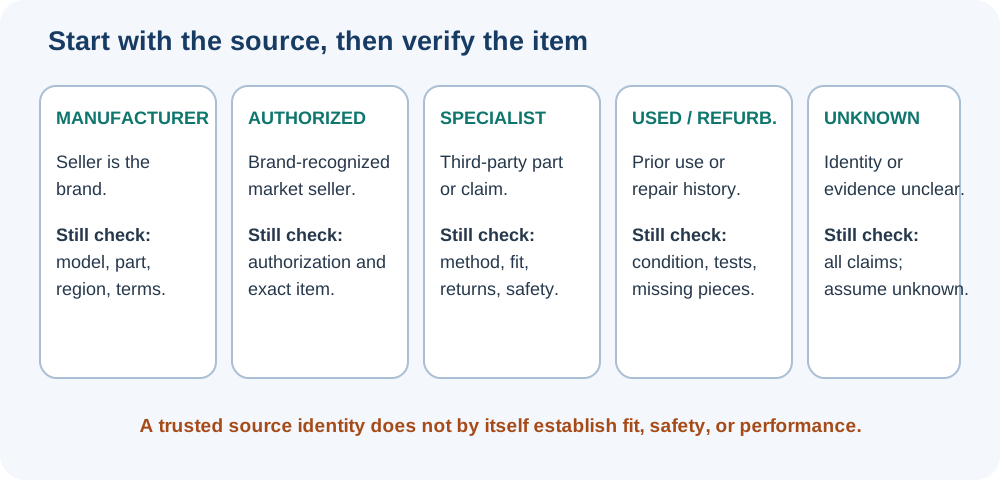
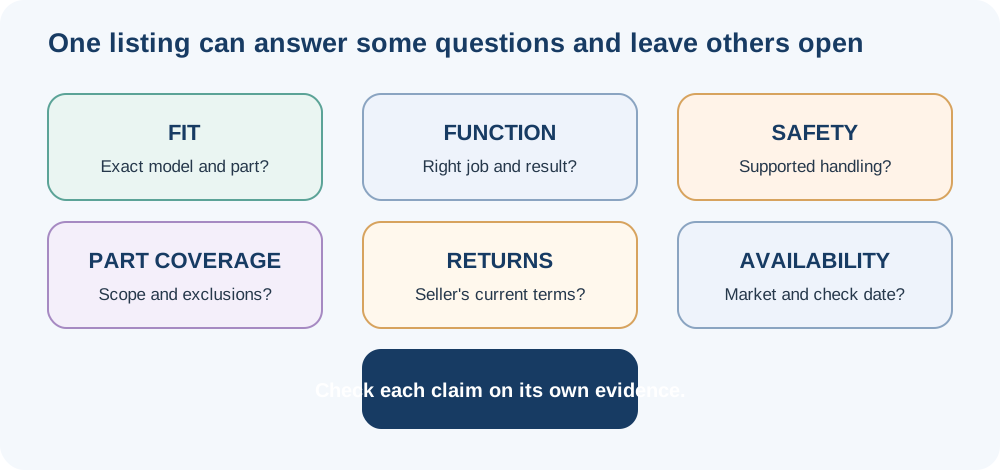
Then assess each claim separately:
- Fit: Does the current source name your exact model, variant, dock, and part number?
- Function: Does it establish that the item performs the job you need, or only that it is sold as compatible?
- Condition: Is it new, used, refurbished, or unspecified? Are all pieces shown and named?
- Safety: Are there instructions and limits for batteries, chargers, water systems, motors, and internal parts?
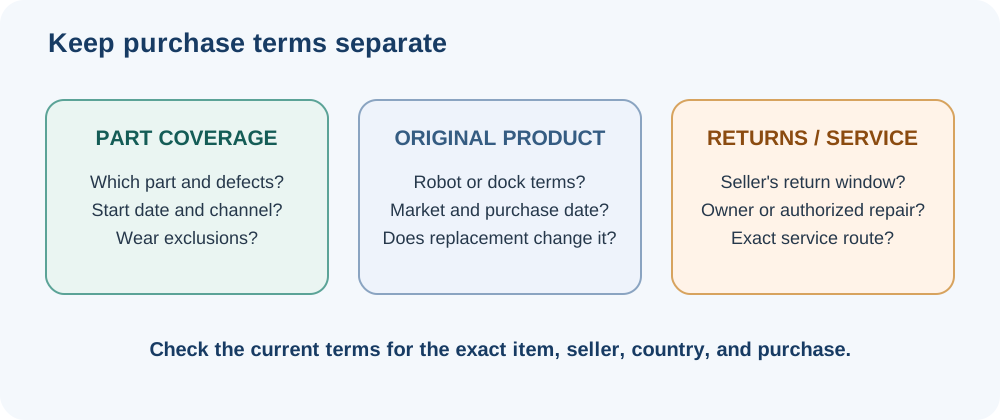
- Replacement-part coverage: Does the part itself have limited coverage, what defects or exclusions apply, and is that coverage separate from the original robot or dock warranty?
- Original-product warranty and service: Check the robot or dock warranty separately. Verify the purchase channel, date, market, component, and whether installation or repair requires an authorized or professional service route.
- Returns: Read the seller’s return terms separately from any manufacturer warranty for the part or original product.
- Freshness and region: Is the listing for the US, UK, or Canada where you will use it, and has its model list or stock status changed?
If you are buying a complete robot or dock across borders, record its country of original sale and your intended country of use. Ask the manufacturer about operation, app binding, and service eligibility separately from physical fit. Narwal’s regional policy, for example, says products sold by Narwal or its authorized retailers are only available for use and after-sales support in the original sale region and warns that a shipment elsewhere may not bind to the Narwal App or perform relevant operations. That manufacturer policy does not establish fitment for every accessory or passive consumable.
Lower price, a familiar brand in the title, a high rating, or a favorable review does not prove compatibility. A seller’s claim is not the same as an official fitment statement. Keep “manufacturer-listed,” “third-party claim,” and “not verified” distinct in your own decision.
A product page can also contain several kinds of statements. Dreame Canada’s 3.2 L dust-bag page lists its own robot model groups and item details, while a customer review on that page makes a broader claim about fit across Dreame robots. Treat that review as one customer’s report, not as the manufacturer’s compatibility field. The page also does not identify a specific dock, so the robot list alone does not resolve an exact base-to-bag pairing.
Check Compatibility & Fitment for any recorded relationship between the exact model and part. A source label or a broad family match does not fill gaps for a model revision or component.
Use a listing checklist
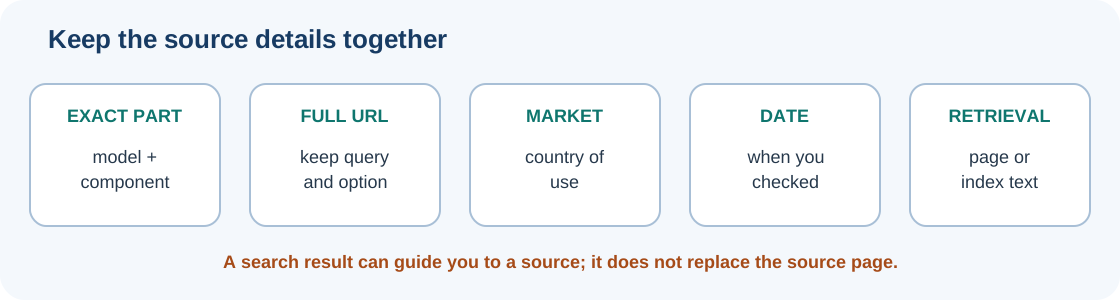
Before ordering, compare the exact robot and dock label with the product page. Record the manufacturer part number and each component in a kit. Save the full URL, including any query parameter, the selected option if shown, the country, the date checked, and whether you read a product page, catalog, support page, or search-index description. A search result is a discovery lead, not confirmation of current package contents. A query parameter alone does not prove that a URL identifies a different physical SKU.
For example, when checked on 2026-10-24, Narwal’s Flow 2 kit base URL did not open, and its indexed description differed from the directly readable URL with variant=52303628501173. The difference does not establish two physical kits or a historical package change. The exact item list and comparison are in the kit verification guide; confirm the selected option with Narwal before relying on it.
For example, iRobot says its own products can be sourced through its store, Customer Care, local distributors, or authorized retailers, and asks buyers to check its authenticity marks on reseller items. This is iRobot’s sourcing guidance; it is not a fitment check and does not establish that the same source rules apply to other brands. Narwal, by contrast, directs US and Canadian customers to contact support for compatibility verification and routes some repair parts through that service path. Follow the route for the manufacturer and region of your own robot.
Roborock’s US repair and spare-parts policy illustrates the difference between a replacement-part warranty and the original product warranty. It gives eligible parts purchased from Roborock or its authorized channels a 90-day limited warranty from delivery for defects in materials or workmanship, but says that coverage applies to the part only. It excludes normal-wear consumables and certain damage tied to improper installation, misuse, modification, unauthorized repair, or failure to follow instructions. This is a US policy example, not a rule for other brands or markets; check the exact terms and return route for your item and purchase.
Encompass’s Eureka parts catalog illustrates what a specialist listing can add: its entry for the exact E10s code NERE10SWH shows schematic locations and part identifiers, including brush assembly 12175000077610. Treat this as catalog evidence for that listed model code. It does not establish seller authorization, fit for every E10s variant, current stock, or owner serviceability; match the complete unit code and confirm the part and service route for your case.
Status pages also need a date and market. In its update dated April 20, 2026, eufy says S1 Pro stopped being available on eufy.com in the US in April 2026 and S1 in June 2026. It says S1 Pro accessories continue to be available, while S1 accessory availability may vary. This is a time-bounded US store statement, not a promise of present stock, future supply, or accessory fit; check the exact current item and your region.
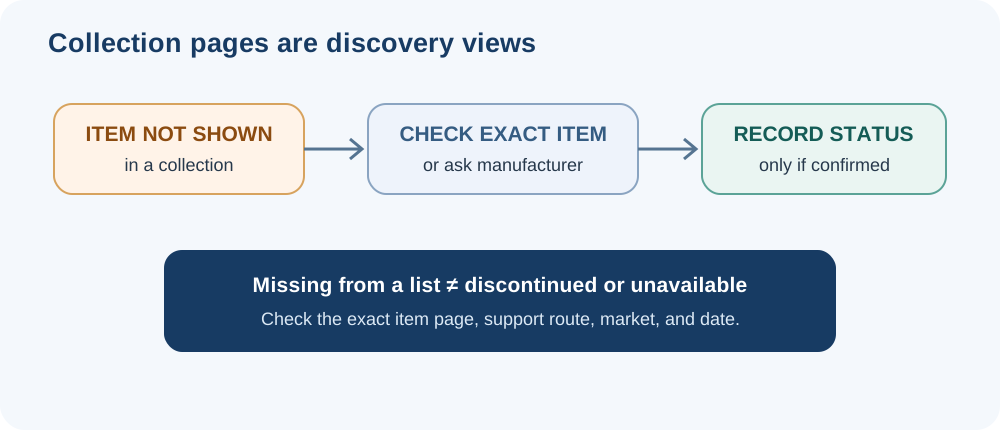
An item missing from a collection page is not necessarily discontinued or unavailable. For instance, the Narwal Flow 2 accessories collection showed five items when checked on 2026-10-24, including separate Standard and Compact Dock filters, but no dock dust-bag listing. A collection is a discovery view, not a complete inventory or a status notice. Check an exact item page or ask the manufacturer before assigning a status.
Keep commercial recommendations transparent
If a site earns a commission when a reader buys through a recommendation, make the relationship easy to notice where the recommendation appears. The U.S. Federal Trade Commission’s affiliate guidance says the relationship should be disclosed clearly and conspicuously. Canada’s Competition Bureau guidance on influencer marketing treats commissions as a possible material connection and calls for clear, prominent, context-appropriate disclosure; a tag, link, discount, or affiliate page by itself is unlikely to be enough. Its current page and 2018 digest address influencer promotions under the Competition Act, not a complete legal audit of every affiliate-publishing arrangement.
UK Advertising Standards Authority and Committee of Advertising Practice guidance distinguishes wholly affiliate-linked content directly connected to product supply from mixed editorial pages. For wholly affiliate-linked content, the commercial nature should be clear before engagement; where only some content or links are affiliate-linked, the relevant content and links should be identifiable before engagement. Apply that guidance to its UK context and the page structure at hand. These sources concern commercial disclosure, not part compatibility or product quality.
Affiliate income, if present, is separate from the diagnostic decision. Establish the model and fitment first, then show a purchase option with its country, seller, and freshness context. Do not imply that a commission, discount, marketplace rating, or manufacturer authorization proves that a part is the right one.
For mixed bundles and part-by-part model lists, use the replacement-kit verification guide. For part selection itself, start with filters, brushes, and mop pads.
Sources & product documentation 15 references
- How do I verify authentic iRobot® products?Primary
- Where to Purchase Accessories & Replacement Parts?Primary
- Regional Availability and CompatibilityPrimary
- Repair Policy and Spare Parts SupportPrimary
- FTC's Endorsement Guides: What People Are AskingPrimary
- Influencer guidance: how to disclose ads and brand partnershipsPrimary
- eufy S1 Pro and S1 Discontinued: Best Alternatives 2026Primary
- NERE10SWH Eureka E10s Robot Vacuum With Self Emptying Station Replacement PartsAuthoritative secondary
- Accessories for Narwal Flow 2Primary
- Advanced Kit for Flow 2Primary
- Advanced Kit for Flow 2, query URL variant 52303628501173Primary
- Dreame 3.2L Dust Bag (X/L/Aqua/Matrix Series)Primary
- The Deceptive Marketing Practices Digest — Volume 4Primary
- Influencer marketing and the Competition ActPrimary
- Online Affiliate MarketingPrimary