If you are comparing Bosch Spotless 2 models in the UK, start with the full variant name. Bosch’s September 2026 release describes three tiers with different mop and navigation systems. The figures below are manufacturer claims, not independent cleaning results.
| Variant named in the release | Published configuration | What Bosch says differs |
|---|---|---|
| Spotless 2 | Two rotating mop pads; up to 25,000 Pa advertised suction | One pad extends and lifts by up to 9 mm. Bosch describes LDS LiDAR with structured-light obstacle recognition. Threshold traversal is stated up to 20 mm. |
| Spotless 2 Advanced+ | Roller mop; up to 30,000 Pa advertised suction | Bosch describes ToF LiDAR, structured light, camera, and infrared sensing. The roller mop is stated to lift by up to 15 mm; threshold traversal is stated up to 20 mm. |
| Spotless 2 Max+ | Roller mop; up to 30,000 Pa advertised suction | Bosch describes side sensors in addition to the listed navigation system. The roller mop lift is stated up to 15 mm; the threshold claim is up to 24 mm. |
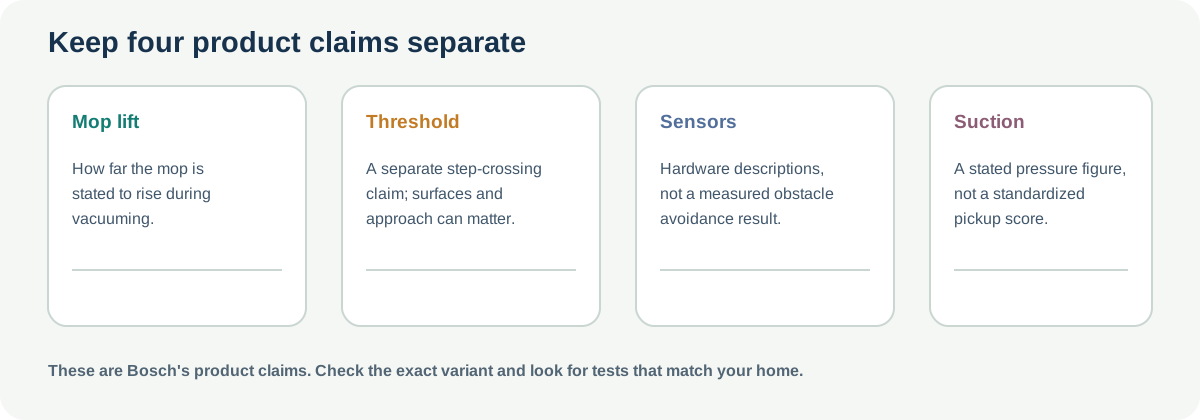
Those details can help you check whether a model’s mop design and stated obstacle sensing match your home. The higher Pa figure is not a standardized cleaning score and does not show how a robot performs on your carpet, edges, or pet hair. Threshold height also does not guarantee that every threshold of that height will be crossed; surface, approach, shape, and test conditions matter.
Check the exact UK model before ordering
Bosch’s UK family page lists Spotless Max Cam as BCRDW3BX and Spotless Max as BCRDW3B. The September release uses Spotless 2, Advanced+, and Max+ names, but the sources do not map those two listed sales identifiers to the release’s three tier names. The UK page also uses broad “up to 30,000 Pa” family wording, while the release assigns up to 25,000 Pa to the entry Spotless 2. Do not assign the release’s figures to BCRDW3BX or BCRDW3B based on the name alone.
The exact BCRDW3B product page identifies it as Spotless Max and lists maximum suction pressure of 11,000 Pa. The Spotless 2 release separately describes Max+ at up to 30,000 Pa. These are statements for different named product pages; the sources do not map BCRDW3B to the Spotless 2 Max+ tier. Ask Bosch or the seller to confirm the exact code before using a release-tier specification for an order.
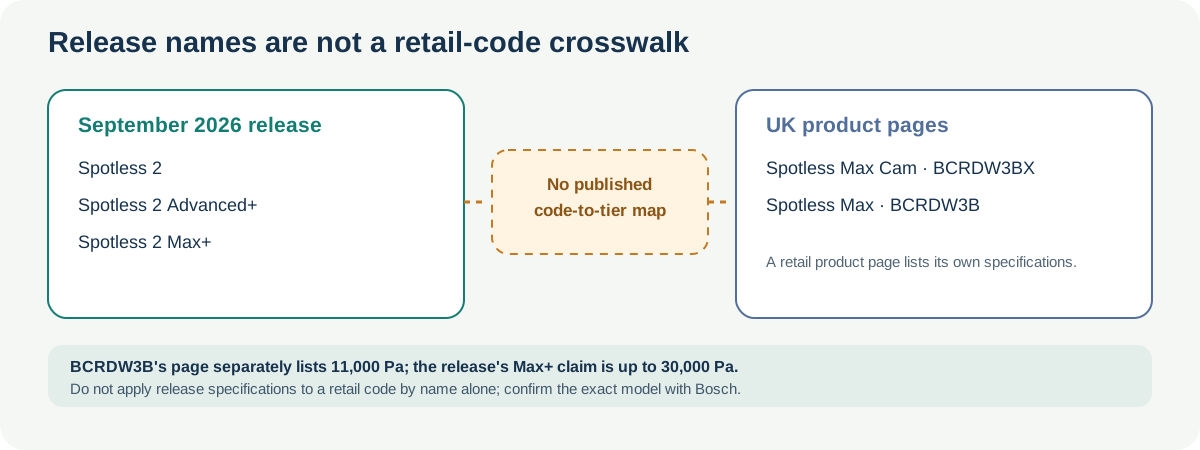
Before checkout, confirm the complete model code on the product page, order, and box; ask Bosch or the retailer how it maps to the release’s variant if the suffix is unclear. Also confirm the included dock and mop parts, delivery, current stock, and the warranty or motor-guarantee terms for that exact UK SKU. The family page’s general guarantee statement does not establish eligibility for every variant.
Check connected features and installation space
The release lists Home Connect app controls for NoGo zones, room-cleaning order, and scheduling, plus Matter integration. Its footnote says some functions require internet access, a Home Connect account, and SingleKey ID, but it does not name every function that depends on them. Verify which functions and integrations are actually available for the exact UK model and software. Do not assume that every basic cleaning run requires an account.
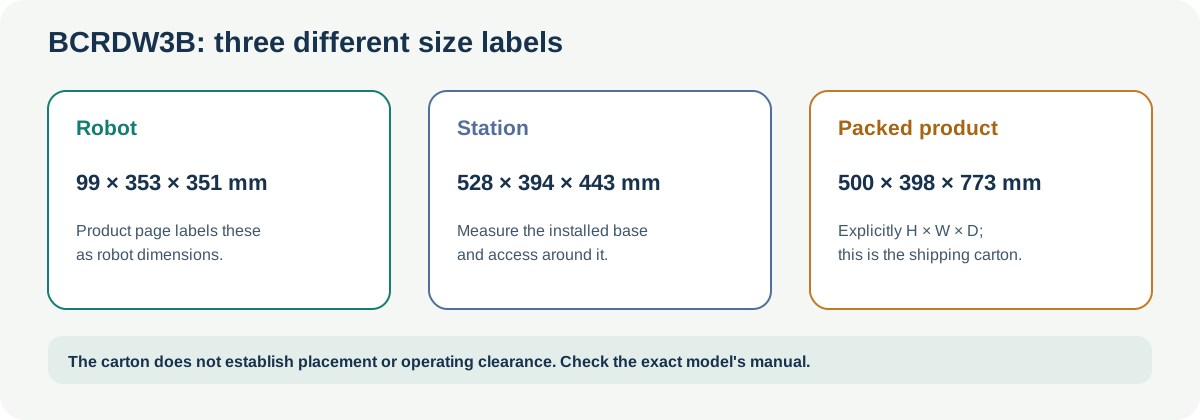
For BCRDW3B, the Bosch product page lists dimensions of 99 × 353 × 351 mm for the robot, 528 × 394 × 443 mm for its station, and packed-product dimensions of 500 × 398 × 773 mm (H × W × D). The carton measurement is for shipping, not installation. Check the robot, station, and manual’s operating-clearance requirements separately, and do not reuse BCRDW3B dimensions for another variant.
Decide from your floor plan
- Prefer a rotating-pad design or a roller mop? Check the actual included replacement parts and the care steps for that exact model.
- Do you have rugs or thresholds near the robot’s path? Compare the manufacturer-stated lifting and threshold claims with measured furniture and floor transitions, then look for independent tests of the exact model.
- Is obstacle sensing important? Treat sensor lists as design descriptions, not proof that cables, toys, or pet waste will always be avoided. Seek current tests that match the obstacles in your home.
For a wider checklist, see how to choose a replacement robot vacuum and how to compare robot vacuum tests. Recheck the official listing before buying: prices, launch timing, stock, included accessories, and terms can change.